martes 24 de noviembre de 2009

Congratulations Louis XX

Dear and fellow monarchists, Its a great joy for me to let you know that our King Louis XX has just announced that his wife the Queen Margarita is pregned and expecting a second child!!

Now more than ever is time to pray God for a male heir to the throne of France, so that the main line of the Bourbons is ensured in order to continue the legitimist claim.

Congratulations Your Majesty!!!!

domingo 11 de octubre de 2009

Rational explanation for the Salic Law in France


Coat of Arms of Princess Eugenia of France, currently the only daughter of our King Louis XX, we shall remember that even she is a daughter of France, she is unable to succeed, and that all the Royalists shall pray for a male heir to Louis XX

We currently live in an egalitarian world, were both sexes have the same rights and obligations, this has affected the lines of succession of several Western countries, which I certainly consider to be a big failure and a potential step before the total abolition of most of the Western thrones.

I totally embrace the feminist views of equality between males and females, however when we talk about a succession to the throne, the things are really different, the Western European tradition is patrinileal and it most be kept that way and not changed through artificial means, this is not against females, many societies arround the world, mostly in Africa were matrilineal, and im sure no one is there trying to change it to be patrilineal just by a decree.

We shall just explore how the lastnames are passed from generation to generation, most Western countries have a really clear naming rules, and the lastname from the father comes first before that of the mother, it is just a cultural feature and not a way of discrimmination.

In France specially the application of the Salic Law (Only male sions of the royal blood could succeed and pass the rights to the throne) has a historical and totally rational explanation, indeed France owes its existence and integrality to the pure and rigid application of the Salic Law.

The Salic Law was applied in order to keep the throne in the hands of French princes of the royal blood, otherwise the throne should have passed in 1328 (Date of the extinction of the main line of the House of Capet) to the son of Isabella of France (Sister of king Charles IV, the last of his House), the king Edward III of England would have succeeded and most likely France would have become a vasal of England, losing eventually its autonomy, culture and nationality.

The Salic Law is totally rational and it saves France of being inherited by a foreign monarch or prince, instead if Salic Law is applicated it is ensured that the throne will be kept by the royal blood line of Hugh Capet founder of its House and of the Modern France.

Nowadays the application of Salic Law is most important than ever, if we consider that most princes are getting married to commoners and the thrones will be eventually inherited by lines of non-royal blood, for example the case of Sweden were the Crown Princess Victoria is engaged to a commoner, their issue will not belong to the House of Bernadotte (Even if the law is changed, according to genealogists and pure royalists the House of Bernadotte will stop reigning after Victoria dies), this is most critical if we consider that the current king has a male heir that was displaced of his rights by a decree of the elected authorities.

Royalists shall always embrace the principle of male-preference inheritance in the Succession of the Western thrones, and always keep in mind that the Salic Law of France is a principle of big importance that shall not be changed, we have also to pray to God, so that Louis XX may have a male heir soon.

sábado 18 de abril de 2009

The Bourbon succession in France


The only legitimate extant line of Capetian descent is the House of Bourbon, whose main cadet line is that of the now differencied House of Orleans. Must of the people in the Western Hemisphere has heard at least once about this powerful royal family, however few of them know why they came to power and from who do they descend.

The true is that France (Their country of origin) has been ruled by the Capetian family since 987 (And since 1848 only de jure), a House whose lay of succession was under the principle of Agnatism, that means that only male line descendants of Hugh Capet (The founder of the House) could acceed to the throne.

Under this principle France was saved from being inherited by an english monarch (Edward III of England), and was able to continue being not only one of the most powerful countries of Europe, but also as a sovereign center of culture, arts, science and monarchist society.

Indeed the french court was for centuries the most wonderfull of all european ones, being a model to follow, founding its peak of influence and grandeur under the reign of the third Bourbon king of France, the great Sun King, Louis XIV that ruled from 1643 to 1715, to date the longest ever reign of an european monarch.

The Bourbon dynasty ruled from 1589 to 1792, and again from 1814 to 1830, with its cadet branch of Orleans usurping the power from 1830 to 1848, after that date there has no been a Capetian ruler of France since then, however the family is extant and waiting for their throne to be restored eventually (I hope so).

Let's explore a little bit of history and reveal how the Bourbons came to the throne. Louis IX (reigned 1226-1270) the ninth monarch of the Main line of the Capetian dynasty, had six sons, the youngest Robert was created Count of Clermont, with no hope of ever inheriting the throne, his elder brother Philip III succeeded Louis IX.

However for 1328 with the death of Charles IV without male issue, the Main line of the Capetian family became extinct, the succession ruled by Salic Law meant that the next monarch was the next most senior capetian, who was Philip, Count of Valois, grandson in the male line of Philip III of France, with his arrival to the throne, the House of Valois began its rule in France (However notice that even they took a different family name, they were still Capetians).

The main line of the Valois became extinct in 1498 with the death of Charles VII, at wich time the line passed to the branch of the Valois-Orleans in the person of Louis XII, great grandson of Charles V of France, his death without any direct male issue in 1515, left the succession open to yet another branch of the House of Valois, this time in the person of Francis I, great-great grandson of Charles V.

The new branch was known as Valois-Angouleme and it would be the last branch of the Valois to rule in France, it was a bad-lucked dynasty that ruled for less than a century, in 1589 with the death of Henry III of France (The last male line scion of the hole House of Valois), the succession was open again.

Up to this time, all legitimate branches of the Capetian dynasty were extinct but two, the Bourbons and the Courtenays, and there was a little problem, the heir of the Bourbons was a protestant and the Courtenays were in poverty and weren't even recognized as princes of the royal blood anymore (They descent was very distant, only descending from Louis VI of France in the male line).

Henry of Bourbon, already King of Navarre was by salic law the new king of France since 1589, however only after he converted to catholicism could really take control of his new and powerful realm, taking the name of Henry IV, the Bourbon era was born, and after the Courtenays became extinct in the male line in 1730, the House of Bourbon became the last branch of the Capetians, to the luck of all the monarchists the House could survive until nowadays with several branches.

However the collateral lines to Henry IV of France are now extinct, the Bourbon-Conde, Bourbon-Conti and Bourbon-Montpensier lines became extinct eventually, thus all current capetians are descended in the male line from Henry IV, other important male lines also became extinct with the pass of the centuries, for example the line of Louis XV and Louis XVI, the main line became extinct after the death of Henry V, Count of Chamboard in 1883, now the main line surviving is that descending from Philip V of Spain, grandson of Louis XIV.

The House of Orleans is now the most junior, only descending in the male line from Louis XIII, if they were to descend to the french throne, all the next branches would have to become extinct before: The Bourbons-France (In the person of Louis XX), the Bourbon-Spain, the Bourbons-Seville, the Bourbons-Two Sicilies, the Bourbons-Parma and the Bourbons-Parma-Nassau.

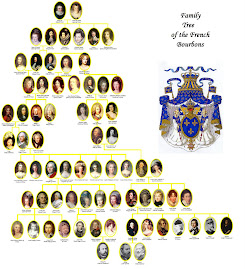
Now we are going to explore the genealogy of the Bourbons, Im going to share with you (My dear lectors) the line of descent from Hugh Capet to Louis XX our current Capetian heir.

Photobucket

jueves 19 de febrero de 2009

Jacobitism Part VI: Henry IX of England, Our Cardinal-King


A child called Henry Benedict Stuart

I've heard of just two cases when a Cardinal succeeded to a throne and became a Cardinal-King, the first case is undisputed, and is that of Henry of Portugal that succeeded at the death of his childless nephew, Sebastian. The second case is however disputed, and is the case that we are going to explore today, the case of Henry Benedict Cardinal Stuart, that for the Jacobites was without any doubt king Henry IX and I of England and Scotland, suceeding his brother Charles III (That died without legitimate issue). Curiously enough both Cardinal-Kings were named Henry.

In both cases the ruling dynasty became extinct in the male line, this led to the Habsburg succession in Portugal and in the second case it lead to the line passing to the House of Savoy, however this also meant that from this point the Jacobite claim became dormant (Or even abeyant), since then no single Jacobite heir has made any public claim to the English throne, leaving the Hanoverian succession uncontested.

For all the past reasons, this will be the last entry on the series of Jacobitism, giving tribute and memory to the last of the Royal Stuarts, Henry Benedict Cardinal Stuart, known to Jacobites as His Majesty Henry IX and adressed as Cardinal-Duke of York at the Papal Court.

Henry Benedict Maria Clement Thomas Francis Xavier Stuart was born in the middle of the exile at Rome, Papal States on 6 March 1725, he was baptized by the reigning pope Benedict XIII (His namesake). Born as the second and last son to the pretender James III of England and his wife, Klementyna Sobieska.


Henry Benedict Stuart in his youth

He had an older brother, the Bonnie Prince Charlie, also known as Charles III of England, subject of study in the past entry. Being the youngest son he was not expected to succeed to the throne (Hoping that Charles would procreate his own legitimate issue), so from a very young age he was prepared to take a formation inside the Church, so he would become a priest.

On his youth he was created Duke of York, the costumary title used for the second eldest son of the reigning monarch, however this title is not recognized by the mainstream royalist community at Great Britain, in fact at his birth the recognized Duke of York, was Prince Ernest Augustus (Brother of George I of Great Britain), and from 1760 to 1767 the title was now on hands of Prince Edward younger brother of George III of Great Britain.

Only one special event related to Jacobitism can be counted in his biography, when he went to France along side his brother to prepare the Jacobite campaign of 1745, however as we have explained in the past entry, this campaign failed and he had to flee again to the Papal States, where he continued with his carrier inside the Church.


The Cardinal-Duke of York

He was soon elevated to the College of Cardinals, when on 30 June 1747, another pope called Benedict, this time the 14th of that name, created him Cardinal-Deacon of S. Maria in Portico, only two months later on August 27 he was eleveated to the four minor orders by the same pope. This showed how much respect and influence had the royal Cardinal at the papal court.

Only one year later on September 1 1748, he was elevated to the degree of Cardinal-Bishop with his titular see still being at S. Maria in Portico, however this changed on 1752 when his see was "transferred" to S. XII Apostoli. During this times Henry few if not communication with his older brother, that was living abroard and was in bad terms with the Catholic church.

On 1761 he was elevated to the position of Cardinal-Bishop with his see at Frascati, to where he move and lived for the rest of his life (Frascati was a suburb of Rome), Frascati was near enough to Rome so he could come everyday on his carriage, to work as the Palazzo della Cancilleria, to where he had right as Vice-Chancellor.


Henry Benedict Stuart in his later years

When his father died on 1766 and his brother succeeded as the Jacobite claimant to the British thrones, he made anything on his hands to try to convince the reiging pope Clement XIII to give his recognition to Charles III, however that recognition never came, in fact from 1766 on the papacy recognized the Hanover monarchs as the legitimate heads of state of the British Islands.

Even holding high offices at the church, now more difficult times were to come to our poor Cardinal-King, his last near relative (His brother Charles III) died on 1788, and even he became for Jacobites the king Henry IX, things were not going to change, and in fact he never made any militar effort to take his thrones.

Another huge blow was coming to Henry's life, the French Revolution meant that the last French Royal benefices had come to an abrupt end, then the french revolutionaries confiscated his properties at Frascati. In the very worst moment of the church, he assisted Pope Pius VI with his last resources, this meant that Henry have now descended to virtual poverty.

In the very last moments, the British minister at Venice arranged a treaty with George III of England, so he would pay an annuity of £4,000 to his rival in the throne, this was seen however only as an act of charity. Henry could then return to Frascati on 1803, and he was now created Dean of the College of Cardinals.


Charles Emmanuel IV of Sardinia, Henry's successor

He was created Bishop of Ostia and Velletri, but remained at Frascati where he died aged 82 on July 13 1807, three years after Pope Pius VII crowned Napoleon Bonaparte as Emperor of the French. He was buried at St. Peter's Basilica. After his death the Jacobite claim passed to his nearest blood relative, Charles Emmanuel IV of Sardinia, however he never made any advance of his new position as Jacobite heir.

Henry's tenure as a cardinal has been one of the longest on papal history serving under five popes (Benedict XIV, Clement XIII, Clement XIV, Pius VI and Pius VII) and living through the tenure of three "legitimate" Dukes of York: Prince Ernest Augustus, Prince Edward and Prince Frederick.


Pius VII, the last pope Henry served

It has been a pleasure to explore the beauty of Jacobitism in this six entries, now I will be talking about Succession Crisis in different thrones, beginning with the arrival to the French throne of Henry IV, and the inauguration of the so interesting and brilliant age of the House of Bourbon.

sábado 7 de febrero de 2009

Jacobitism Part V: Charles III (Bonnie Prince Charlie)


Bonnie Prince Charlie in his youth

One of the most romantic and interesting figures from Jacobitism, is the prince Charles Edward Stuart, known by his supporters as Charles III of England (From the death of his father James III at 1766), known by neutral people as "Bonnie Prince Charlie" for his tender and handsome looks, and known by his opponents simply as "The Young Pretender".

Charles Edward Louis John Philip Casimir Sylvester Maria Stuart, was born in the exile at Rome on December 31, 1720 at the Palazzo Muti, being the eldest son of the reigning Jacobite king James III and VIII and his wife, Queen Clementina Sobieska.

As heir apparent to the Jacobite throne, he was soon created Prince of Wales in his own right, and became the great hope for the Jacobites, believing that the dynasty was secured with the birth of a male heir, however future would prove that the handsome prince would fail to produce any legitimate issue.


Charles Edward Stuart on 1729

At the age of five, his only brother was born, christened as Henry Benedict Stuart (Subject to our next entry), they grew together spending their childhood at Rome and Bologne, largerly appart from their mother Clementina who was stranged from their father for most of their lives.

Clementina died on 1735 when Charles was still a minor, with just fourteen years, his brother Henry Benedict was barely nine years old. Most of the youth of Charles was peaceful living in the Papal court and recognized as one of the most handsome princes from his age, ironically his father failed to get a good match for his son.


Charles III in his best years

At Great Britain, Charles was seen as a major threat to his Hanoverian counterparts, because of his youth and handsome looks, Charles attracted romantic publics specialy from the higlands of Scotland, he was soon nicknamed "Bonnie Prince Charlie", this "AKA" was special since his princely status was then recognized by the masses.

His father recognizing the popularity of his son, decided to name him "Prince Regent" in december 1743, this giving him the Royal assent to act in the name of the reigning James III, from then on, Charles was the factual leader of the Jacobite cause, as would be demosntrated two years later.

On 1745, Charles launched a full invassion to the British Island, in a last effort to recover the thrones for his father, he issued a manifesto claiming for the supports of his fellow subjects in order "to restore the holy throne to the legitimate cause of the Royal Stuarts".

He found much support at the Highlands of Scotland, however the support was not universal, and even he made very important victories, like that in the Battle of Prestonpans, and later that in Falkirk, his expedition reached as far south as Derby, however he was finally defeated and had to retreat to the highlands.


Statue of Charles III at Derby, the southernmost place he visited on 1745

Charles wandered for about six months in the Highlands until he finally decided to left to Scotland on September 20, feeling totally dissapointed and defeated, after this point the Jacobitism was hopeless, and no other single militar intervention would be made in order to try to restore the line of the Royal Stuarts.

The next years, Charles resided at France where he found many loves and adventures, one affair with a cousin Marie-Louise de La Tour d'Auvergne who was married to the duc de Montbazon, resulted in the birth of an illegitime son: prince Charles de Rohan, however he died at five months, had he lived he would still be barred to the succession being a royal bastard.

On June 16, 1748 the final fate of the Jacobitism was signed, when France oficially recognized the Hanoverian claim to the british thrones through the Treaty of Aix-la-Chapelle, Charles was then barred from entering France, and he would wonder arround the European continet in the following years, eventualy establishing at the duchy of Lorreine and finally to the Low Countries.


Charles III in his older years

At Liege he renewed a past relationship with Clementina Walkinshaw, who gave him another illegitimate child, this time a daughter who was baptized as Charlotte. During this times he became very anti-catholic, this because of his anger against the Pope and France who have turned down any hope to help the Jacobite cause. It is even pressumed that Charles oficialy became a member of the Church of England in a desperate last try to recover his throne.

However at the end when his father died in 1766 he decided to return to Rome, took up residence at the Palazzo Muti, however the Papal courts decided to not give their recognition to Charles III instead choosing to finally accept the Hanoverian succession at the British Islands.

Even his brother (Now a Cardinal) tried to gain the papal favor, all negotiations failed. Now Charles was old and tyred, and still without a heir to be succeeded, then on 1772 he was married to a very obscure princess from a ducal line, Princess Louise of Stolberg-Gedern, daughter of Prince Gustavus Adolphus of Stolberg-Gedern and of his wife, Princess Elizabeth of Hornes.


Louise, Charles' wife

The new coulpe was happy even Charles was thirty years senior to his new wife, however they failed to produce any issue, and thus the Jacobite succession was then left to the Cardinal-Duke of York, that for obvious reasons was also childless.

Charles and Louise lived at Florence since July 1774, where Charles drunkness became more serious and Louise began to be courted by a series of young men. Eventualy Louise conduct was obviously adulterous, so he and Charles broke up on 1778 and she went to live to a convent two years later, the couple would never meet each other again.

In 1783 Charles signed an act in order to legitimize his only surviving daughter, Charlotte, who was then styled as Duchess of Albany, however the legitimization did not gave her any right to the Jacobite succession, they moved to Rome on 1785. At this time Charles was virtually invalid and senile, however he became totally reconciled to his original Roman Catholic faith.


Charles III of England in his later years

Charles died in the Palazzo Muti, (the very same place where he was born), on January 30, 1788, his remains first were first laid to rest at the Cathedral of Frascati, but finally was sepulted along with his father and brother at the Crypt of the Saint Peter's Basillica. Charles was succeeded in all his rights, by his younger brother, Henry Benedict, Cardinal-Duke of York.

lunes 26 de enero de 2009

Jacobitism Part IV: Louisa Maria Teresa, Princess over the water


The young princess with his brother James III in an allegorical painting

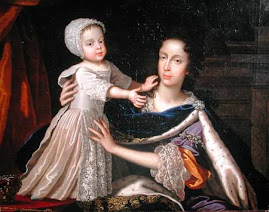
It is beautiful to dedicate a full entry to such a wonderful and beautiful princess, our well beloved Louisa Maria Teresa Stuart, for the jacobites, known as the princess over the water and also as the Princess Royal. Louisa Maria Teresa is well remembered and glorified by jacobites, as she was the only legitimate daughter (To survive infancy) of any Stuart jacobite pretender.

Louisa Maria Teresa was born on 28 June 1692 at Saint-Germain-en-Laye, France, well after his father have been deposed as monarch of the British Islands in 1688. She was not the first baby girl to be born to James II and his second wife Mary of Modena, other three girls have been born earlier but died very young, Catherine Laura, Isabel and Charlotte Maria.

Louisa Maria Theresa had two surviving elder half-sisters from his father's first marriage with Anne Hyde, this were Mary and Anne both of whom became queens after his father was deposed, being raised as protestants, Louisa Maria Teresa would never meet them, Mary II in fact died in 1694 when Louisa was barely two years old.

At the time of her birth, James II invited many people to attend the birth (To prevent the controversy that happened some years before at James III's birth in which no relevant courtesans were present, and rumours started accusing James II of having the baby substituted, this of course was false), even Mary II was invited, however she did not attend.


Louisa Maria Teresa during her childhood

Louisa's whole life happened at the France of Louis XIV, living at the court and being treated oficially as an english princess in all of her right, her tutor was a Roman Catholic english priest, the father Constable, who taught her the royal latin, royal history and of course catholic religion, the princess was very intelligent and recognized as one of the most beautiful of her times.

Soon the princess over the water became a companion and a true friend to her devastated mother Mary of Modena, when in 1701 his father died, his brother became for jacobites and the catholic monarchs, as James III of England, now Maria Louisa was sister to a monarch and as such was recognized as one of the highest ranking princesses at the Royal Court of France.


The beautiful princess

She was very popular at the court, and several candidates were presdenter for her to marry, the most likely were Charles, Duke of Berry (Grandson of Louis XIV in the male line) and the king Charles XII of Sweden, however none of this became real, to the first most likely because of Louisa Maria Teresa's uncomfortable position, and the second because Charles XII was protestant.

Unfortunately the princess didn't live long enough to marry and have children of her own, in april 1712 both she and her brother fell ill with smallpox, she died, her brother survived. It was a huge shock for her mother Mary of Modena, who was devastated with the loss of her only daughter.

The premature death of our dearest princess was a huge loss for the jacobite cause, she could have well created her own line of descendants that would eventually succeeded to the jacobite claim after the death of his grand-nephew Henry IX, Cardinal-Duke of York.

In the next entry I would talk about, the very famous Bonnie Prince Charlie, the next in the Jacobite succession, who claimed the british thrones as Charles III, for her opponents he was known as the Young Pretender, after his father who was known as the Old Pretender.

jueves 25 de diciembre de 2008

Jacobitism Part III: James III of England "The old pretender"


James III, Jacobite pretender from 1701 to 1766. Have he really reigned, his reign (At 64 years) would be the longest in British History, surprassing the 63 years reign of Queen Victoria

It is a pleasure to me to talk about such a great person as James III was, I'll try to be objective and be always the nearest to the reality as possible, but I can not occult that I really have an admiration for this romantic figure, the "King over the water" also known by its opponents as "The old pretender".

James Francis Edward Stuart was born on 10 June 1688 to the reigning monarch James II of England and his second wife, the italian princess Mary of Modena .The birth took place at St. James Palace, the very same place were his father was born almost fifty five years before on 1633.

Even James II had already two daughters born from his first marriage, both English and Scottish thrones were ruled by male-preference primogeniture on theirs succession systems, and thus the newly born became immediately the first on the line of succession to both thrones and as such Duke of Cornwall and Duke of Roteshay.

The english people feared at that times that a popist plot was behind their current monarchs, a generalized anti-catholic sentiment was prevalent at the moment, vissible in so many cultural expressions such as the very frequent mocks to the Catholic hierarchy, including the reigning pope.

With that huge problem behing the british thrones, the people simply was not willing to accept a Catholic Dynasty, the birth of James Francis Edward meant that the throne should continue in the catholic line of the Royal Stuarts, many peopke at the Parliament however meant that it was time to take action before the Catholic dynasty could establish itself.

Soon rumors started to circulate among the masses, discrediting the birth of the young James, rumors included the false statement that in fact the actual baby had been born dead and it was soon replaced by another false baby, this rumor quickly grew since there were no relevant courtesans or nobles present at the birth.


Mary of Modena, James' mother and Queen of England and Scotland

Soon the situation became very unstable at England, a revolution was coming and the throne of James was more unsure than ever, on 10 December of the very same year of 1688, when the baby James was barely six months old, Mary of Modena his mother, took him with her to France in order to search for a better place, while his father James II tried without any succes to retain its moribund Crown.

A few weeks later James II joined his wife and baby son, and in 1689 his eldest daughter was crowned (By the will of the parliament) as Queen Mary II of England in a co-reign with her husband William III of Orange, however many people (Including some major European powers) view this as a clear usurpation, believing that the Parliament had not the right to change the order of succession.

James II always had the firm conviction that some day he would recover his throne, and continued to sign documents as the reigning monarch, as explored in the previous entry, the group that formed arround him in order to bring support, became known as Jacobitism and the young prince James was the focus of all the Jacobite interest, it was in fact the bright hope of a futute restoration, had James Francis Edward died before his father, for sure the Jacobitism would have become dead with it, however he lived long enough.


James with his sister, Louisa Maria Theresa "The Princess over the water"

At France, James was recognized as the true heir to the English and Scottish thrones, and threated as a Prince of Wales. On 1692 when James was four years old, a baby sister was born to his father and mother, the beautiful girl was called Louisa Maria (Later the name Theresa was added, and she is now known more commonly as Louisa Maria Theres Stuart) and would become a companion to the young prince, numerous portraits were made showing both princes.

The prince grew then at the french court, with his parents and his only full-sister to survive infancy, who was styled as the "Princess Royal" or called by the jacobites as the "Princess over the water", during this times James began a very strict catholic education and learned both english and french.

On 16 september 1701, his father James II died when he was just thirteen years old, he immediately proclaimed himselg with the support of Louis XIV and several other major catholic monarchs, as James III of England and VIII of Scotland refusing to recognize his half brother-in-law William III as a monarch, and after 1702 also refusing to recognize his half-sister Anne.

After this the English Parliament oficially removed all of his British titles and accused him of High-Treason under the penalty of death, however all the Jacobite community (Including four catholic states) still addresed him as a Majesty and as the rightful King of both England and Scotland.


Queen Anne, half-sister of James III and also his rival for the throne

After James came to age, it was time to try to regain his lost throne, after a brief illness associated with measles, James tried to land at the Firth of Forth however he failed when a fleet led by Sir George Byng (Loyal to Queen Anne) forced the french ships (Supporting James) to retreat.

It was just the beginning of a tragic series of events to lead to the total betrayal and lost of hope to the still young James III. France was in the middle of a continental war, the War of Spanish succession trying to ensure that Philip, Duke of Ajou (Grandson of Louis XIV in the male line, and thus a Bourbon) was accepted as the new king of Spain succeeding the now extinc line of the Spanish Habsburgs.

On 1713 the peace came with the Treaty of Utretch in which England finally accepted Philip V as the king of Spain, however it cost among others things to France, that Louis XIV had to accept Anne as the true Queen of England, leaving James III without the so much needed recognition of the French Court.

The tories, a parliamentarian group held restorationist views and even supported to a some degree James III, however it was obvious that he had to rennounce to his catholic faith in order to be accepted as British Monarch, however James III strong in his ideals refused to do so, even it meant that he lost any real hope to regain his throne.


George of Hanover became in 1714 George I of Great Britain being the nearest protestant relative to the protestant Stuarts

In 1714 Anne died, and with her the protestant branch of the Royal Stuart family, by the Act of Settlement the throne passed to a german prince, skipping not only James but a bunch of at least another forty nearest relatives that were considered unfit to rule over Great Britain because of their catholic faith.

The german prince, elector of Hanover in his own right, became then George I of Great Britain (In 1707 the parliament merged the english and scottish kingdoms to create the new realm of Great Britain, however the jacobite heirs continued to style themselves kings of the separated realms of England and Scotland).

On 1715 (Known as "The fifteen" by Jacobites)James III made his last effort to recover his crown, finally landing at Scotland, however he was very much dissapointed by the lack of support that he found, he had planned a coronation at Scone, but decided to retreat and left before being captured by the Hanoverian troops.

He was not welcomed again at France, that very same year his patron and protector, Louis XIV, died and was succeded by his child great-grandson, Louis XV under the regency of Philip II, Duke of Orleans, which saw James as an embarrassment and did not let him to come back to Versailles.


Pope Clement XI received the Jacobite court at Rome, where it stayed until its final days

Affortunately for James, the reigning pope Clement XI offered James a pension and the palace of Mutti in Rome as his new ressidence, James immediately accepted the offer and established for the rest of his life at the Papal States, specialy at the eternal city of Rome.

It was there that on 1719 James contracted marriage with the polish princess, Maria Clementina Sobieska,a granddaughter of the polish king John III Sobieski, trying to ensure the continuation of the Royal Stuart catholic line, one year later came the first child, that for the great pleasure of all the Jacobite community, resulted to be a babyboy, that was called Charles Edward, and would later become known as the Bonnie Prince Charlie and The young Pretender by its opponents (Of course a full entry would be dedicated to this beloved prince).


Maria Clementina Sobieska, Consort to James III and Queen of England and Scotland for Jacobites

Five years later came the second and last son of the marriage, Henry Benedict Stuart, that would become cardinal and Jacobite King in it's own right, and that for the sadness of the general Jacobite communite was to be the very last member of the Royal Stuart family.

The marriage of James and Clementina was a sorrowful one, totally unhappy and a big failure, Clementina accused James of adultery and soon after the birth of Henry Benedict, she decided to leave her husband and live at a local monastery, it would take two years before a reconciliation could came.

Clementina was prone to depression and as a fervant catholic he spent much of her time praying, distanced of both her husband and children. She would die in 1735, at the very early age of 32 years, recognized as the true and legitime Queen of both England and Scotland, she was interred with full royal honours at the St Peter's Basilica at Rome.

James would never marry again, and in fact he felt in a perpetual state of lethargy, spending all his time at his palace surrounded by his "Jacobite court in the exile" that was mantained by the pension payed by the Papal States. In fact in 1743 formaly retired from "polithics" when he oficially invested his eldest son, Charles, as the "Prince Regent" thus giving him full powers to act in his name.

On 1745 (The famous Forty-Five) the young and handsome, Charles Edward, made the last serious effort to recover the British thrones for his father, even he came closer to success than his father's 1715 invassion, he eventualy failed and all the factual hopes for an eventual Jacobite restoration were effectively destroyed.


Tomb of James III at St.Peter's Basilica, shared with his two sons and successors

James would die on 1 January 1766, yes the very first day of the year 1766, he was buried at the St. Peter's Basilica as his wife. Thirteen days after his death, the papacy oficially decided to recognize the Hanoverian Dynasty as the true and legitime rulers of Great Britain.

On the next entry I will talk about Louisa Maria Theresa, sister of James III, even little information is available, she well worths an entry, being an important Jacobite figure by her own right.